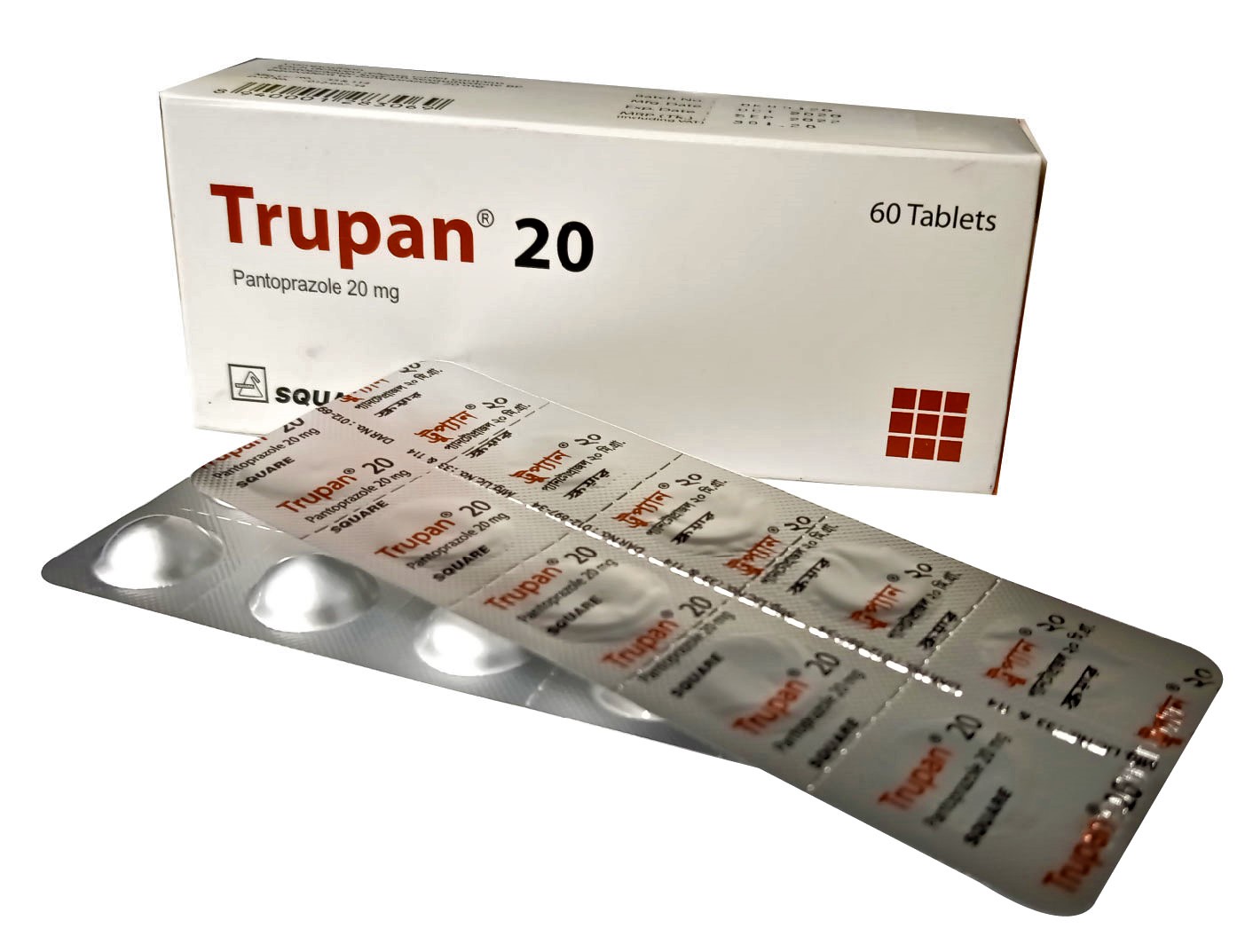
Trupan 20
Tablet-(20mg)
More from Square Pharmaceuticals PLC.
About this item
Trupan 20 mg is recommended when inhibiting acid secretion is therapeutically beneficial, i.e. Stomach ulcer disorders. Illnesses caused by gastroesophageal reflux. Non-steroidal anti-inflammatory drug-induced ulcer (NSAIDs) Helicobacter pylori eradication (in combination with antibiotics) Syndrome of Zollinger-Ellison
Medicine Overview
Indication:
Peptic ulcer disease, H. pylori infection, Gastro-oesophageal reflux disease, Zollinger-Ellison syndrome, Oesophagitis, Acid-related dyspepsia, NSAID-associated ulceration, ulcer resistant to H2 receptor antagonists, Gastrointestinal (GI) bleeding from stress, Prophylaxis for acid aspiration syndrome during induction of anaesthesia
Administration:
Controlled-release: Should be taken on an empty stomach. Take 1 hr before meals. Swallow whole, do not chew/crush. Normal release: May be taken with or without food. IV Preparation GERD with a history of erosive esophagitis 15-min infusion: Reconstitute with 10 mL NS, THEN further dilute with 100 mL D5W, NS, or LR to final concentration of 0.4 mg/mL Zollinger-Ellison syndrome 15-min infusion: Reconstitute each vial with 10 mL NS, THEN Combine 2 vials and further dilute with 80 mL D5W, NS, or LR to total volume of 100 mL (concentration 0.8 mg/mL) 2-min injection: Reconstitute with 10 mL NS to final concentration of 4 mg/mL IV Administration Infuse over 15 min no more than 3 mg/min (7 mL/min) for GERD and 6 mg/min (7 mL/min) for pathologic hypersecretory conditions
Adult Dose:
Erosive Esophagitis Associated With GERD Treatment: 40 mg PO qDay for 8-16 weeks Maintenance of healing: 40 mg PO qDay Alternatively, 40 mg IV qDay for 7-10 days Short-term Treatment of GERD Oral therapy inappropriate or not possible: 40 mg IV infusion over 15 minutes qDay for 7-10 days; switch to PO once patient able to swallow Zollinger-Ellison Syndrome 40 mg PO qDay; up to 240 mg/day administered in some patients 80 mg IV infusion q8-12hr up to 7 days; switch to PO once patient able to swallow Peptic Ulcer Disease Duodenal ulcer: 40 mg PO qDay for 2-4 weeks Gastric ulcer: 40 mg PO qDay for 4-8 weeks Elderly: No dosage adjustment needed. Hepatic impairment: Max: 20 mg/day or 40 mg on alternate days.
Child Dose:
Erosive Esophagitis Associated With GERD <5 years: Safety and efficacy not established >5 years 15 kg to <40 kg: 20 mg PO qDay for up to 8 weeks 40 kg or greater: 40 mg PO qDay for up to 8 weeks
Renal Dose:
Renal impairment: No dosage adjustment needed.
Contraindication:
Concomitant use w/ rilpivirine, atazanavir and nelfinavir. Lactation.
Mode of Action:
Pantoprazole is a substituted benzimidazole, and also known as PPI due to its property to block the final step of acid secretion by inhibiting H+/K+ ATPase enzyme system in gastric parietal cell. Both basal and stimulated acid are inhibited.
Uses
1-10% Headache (>4%),Abdominal pain (4%),Facial edema (<4%),Generalized edema (<2%),Chest pain (4%),Diarrhea (4%),Constipation (<4%),Pruritus (4%),Rash (4%),Flatulence (<4%),Hyperglycemia (1%),Nausea (1%),Vomiting (>4%),Photosensitivity (<2%) Frequency Not Defined Angioedema,Atrophic gastritis,Anterior ischemic optic neuropathy,Hepatocellular damage leading to hepatic failure,Interstitial nephritis,Pancreatitis,Pancytopenia,Rhabdomyolysis,Risk of anaphylaxis,Stevens-Johnson syndrome,Fatal toxic epidermal necrolysis,Erythema multiforme
Precautions
Gastric malignancy should be ruled out. Consider Zn++ supplementation during IV therapy in patients who are prone to Zn++ deficiency. Pregnancy. Monitoring Parameters Monitor Mg levels prior to initiation and periodically during prolonged use. Lactation Risk Summary Pantoprazole has been detected in breast milk of a nursing mother after a single 40 mg oral dose of pantoprazole. There were no effects on the breastfed infant. There are no data on pantoprazole effects on milk production. The developmental and health benefits of breastfeeding should be considered along with the mother’s clinical need for PROTONIX and any potential adverse effects on the breastfed child from pantoprazole or from the underlying maternal condition.