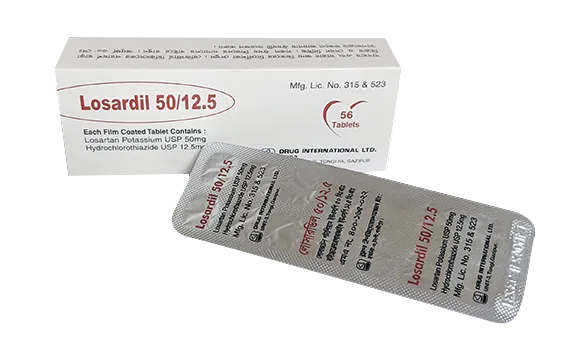
Losardil 50
Tablet-(50mg)
More from Drug International Ltd.
About this item
Losardil 50/12.5 is a combination of two medicines. It helps to control high blood pressure in different ways. If high blood pressure is not treated it can lead to heart attacks, strokes and kidney failure. You can take Losardil 50/12.5 with or without food. The dose will depend on your condition and how your respond to the medicine. Try to take it at the same time each day. It is important to keep taking this medicine until your doctor tells you not to. It contains a diuretic (water pill) and will make you urinate more so, it is best to avoid taking this medicine within four hours of going to bed. Use this medicine regularly to get the most benefit from it even if you feel well. High blood pressure does not usually have symptoms and if you stop taking it your risk of heart attack or stroke may increase. The most common side effect is dizziness. Other side effects include feeling tired, nausea, diarrhoea, headache, and decreased blood pressure. Frequent urination is not a side effect of this medicine. It is the purpose of hydrochlorothiazide and helps control your blood pressure. You may experience other possible side effects, but most are rare. Make sure you read the leaflet that comes with your medicines and tell your doctor if you are bothered by side effects or they do not go away. It may be possible to adjust your dose or try a different medicine. This medicine is not recommended during pregnancy and you should ask your doctor before taking it if you have kidney or liver disease, heart trouble or diabetes. Drinking alcohol can further lower your blood pressure and may cause side effects.
Medicine Overview
Indication:
Diabetic nephropathy, Hypertension, Stroke risk reduction of hypertensive or LVH patients, Heart Failure, Hypertensive Patients with Left Ventricular Hypertrophy
Administration:
May be taken with or without food.
Adult Dose:
Oral Hypertension Adult: 50 mg once daily, may increase to 100 mg/day as single dose or in 2 divided doses if needed. Patients w/ intravascular volume depletion: Initially, 25 mg once daily. Diabetic nephropathy in Type 2 diabetes mellitus Adult: Initially, 50 mg once daily, may increase to 100 mg once daily depending on BP response. Heart failure, Hypertension and Left Ventricular Hypertrophy, Stroke risk reduction of hypertensive or LVH patients: Adult: Initially, 50 mg once daily. Hydrochlorothiazide 12.5 mg daily should be added and/or the dose of Losartan should be increased to 100 mg once daily followed by an increase in hydrochlorothiazide to 25 mg once daily based on blood pressure response
Child Dose:
Hypertension <6 years: Safety and efficacy not established Child: >6 yr 20-50 kg: Initially, 0.7 mg/kg. Max: 50 mg/day; >50 kg: Initially, 1.4 mg/kg. Max: 100 mg/day.
Renal Dose:
Renal impairment: CrCl <20 ml/min: Initially 25 mg once daily.
Contraindication:
Losartan potassium is contraindicated in patients who are hypersensitive to the active ingredient or any component of the drug. Concomitant use w/ aliskiren in patients w/ diabetes and renal impairment (GFR <60 mL/min). Severe hepatic impairment. Pregnancy.
Quick Tips:
• Take it at the same time every day to help you remember to take it.
• It can make you feel dizzy for the first few days. Rise slowly if you have been sitting or lying down for a long time.
• Your doctor may get regular tests done to monitor the level of urea, creatinine, and potassium in your blood.
• Avoid taking anti-inflammatory medicines such as ibuprofen along with this medicine without consulting your doctor.
• Do not take Angilock 50 if you are pregnant or breastfeeding.
• Do not stop taking it suddenly without talking to your doctor.
Uses
Hypertension (high blood pressure)
Heart failure
Prevention of heart attack and stroke
Side Effects
Common
Dizziness
Decreased blood pressure
Hypoglycemia (low blood glucose level)
Increased potassium level in blood
Increased blood urea
Precautions
Volume-depleted patients including patients on high-dose diuretics. Patients w/ bilateral renal artery stenosis , aortic or mitral stenosis. Renal and mild to moderate hepatic impairment. Lactation. Monitoring Parameters Monitor BP, electrolytes and renal function. Lactation: Unknown if excreted in milk; not recommended